

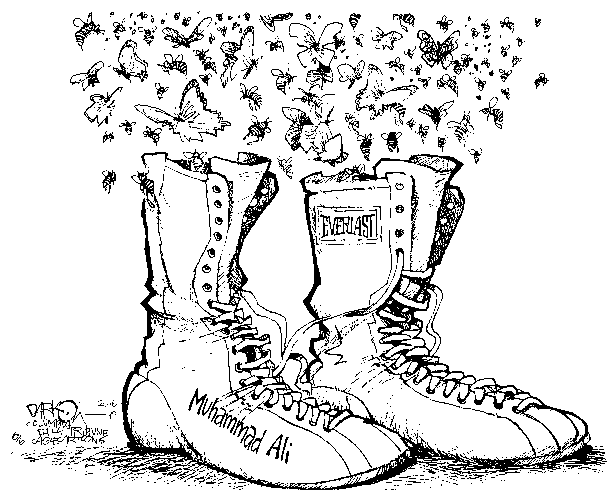
Since the news broke of his death on Saturday, there have been countless stories, opinions and reflections about Muhammad Ali.
For those too young to remember Ali, it might be tempting to dismiss him as just a former athlete from another time. That view fails to understand Ali, his place in history and relevance now.
Born Cassius Clay in Louisville, Ky., in 1942, he was a product of the Jim Crow era in the United States, where African-Americans, even athletes whose exploits garnered public attention and admiration, were treated as second-class citizens.
This was certainly true of Ali, whose athleticism and boxing skills earned him Golden Gloves titles and Olympic gold. He would go on to hold the heavyweight crown three different times over a 21-year professional career — including a number of legendary fights like the surprise victory over heavyweight champion Sonny Liston in 1964, where Ali proclaimed himself “the greatest” to three slugfests with Joe Frazier, including the “Thrilla in Manilla” and “Rumble in the Jungle” in Zaire.
His skills as a boxer, however, were just part of what made him famous. He was known as the Louisville Lip, full of bravado, poetry, willing to speak his mind.
Cassius Clay converted to the Nation of Islam in 1964 and settled on the name Muhammad Ali. He told the press at the time: “Cassius Clay is a slave name. I didn’t choose it and I don’t want it. I am Muhammad Ali, a free name — it means beloved of God, and I insist people use it when people speak to me.”
That was not something many people, including many white sportswriters and columnists understood, let alone accepted, especially during the turbulent times of the Civil Rights era.
He didn’t endear himself to others when he refused to enter military service, becoming an outspoken critic of the Vietnam War. That landed him a five-year prison term, which was overturned by the Supreme Court. But it cost Ali his title and kept him out of boxing for four years.
A polarizing figure, he nevertheless was a force of change, one that demanded the public take an unvarnished view of race in America and around the world, one that sought justice.
In saying things that made people uncomfortable, while standing up to the backlash that often ensued, Ali understood this was the power necessary for change. Sure, that voice was muffled by Parkinson’s the last couple of decades, limiting his speech and mobility.
Yet, as Ali once said, “I am America. I am the part you won’t recognize. But get used to me. Black, confident, cocky; my name, not yours; my religion, not yours; my goals, my own; get used to me.”
Consciously or not, Ali remains a model for countless other people around the globe who speak out against the injustices they see. Even after death, there is much to learn from one of the American icons of the 20th century.