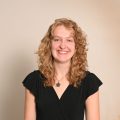
SUNDERLAND — The three remaining candidates for former state Rep. Natalie Blais’ seat faced off Wednesday night at the Sunderland Democratic Town Committee’s forum, highlighting the skills they feel they can bring to Beacon Hill.
Blais resigned on Jan. 19. As Speaker of the House Ronald Mariano opted not to call a special election to replace her, Blais’ seat will remain open until the November 2026 election. The winner will be sworn in next January to represent the 1st Franklin District.
The three candidates shared similar opinions on a range of issues impacting the 1st Franklin District — from affordability to housing, economic development, public school funding and federal cuts to programs for several causes.

Candidates for the 1st Franklin District seat answer questions at Wednesday night’s forum at the First Congregational Church of Sunderland. Credit: AALIANNA MARIETTA / Staff Photo 
About 70 people visited the First Congregational Church of Sunderland on Wednesday to hear from the 1st Franklin District candidates. Credit: AALIANNA MARIETTA / Staff Photo
“We have three strong women running, which is amazing,” said Greenfield City Council President Lora Wondolowski, a Democratic candidate who works as director of advancement and communications at the Peace Development Fund, an Amherst-based foundation that supports social justice organizations across the country.
Wondolowski brings decades of advocacy work after working at the National Audubon Society and the League of Conservation Voters in Washington D.C., as well as with the Massachusetts League of Environmental Voters. Wondolowski also served on the board of directors for several nonprofits, helped found the Friends of the Great Falls Discovery Center and served as the founding executive director of Leadership Pioneer Valley.
“Experience matters, but so does courage in these times,” she said. “I’m running to build what comes next. Our district deserves leadership that listens to the community’s challenges and builds tomorrow’s solutions. These times call for people who are unifiers.”
Corinne Coryat, another Democratic candidate and former aide for Blais, is also running. Before working for Blais, Coryat worked with Mass Audubon and U.S. Sen. Ed Markey’s 2020 campaign while earning her degree at Clark University in Worcester, and then got involved with the Franklin Regional Council of Governments (FRCOG), researching housing plans and the best paths to secure state support. She is currently finishing a law degree with a concentration in public interest law at Western New England University.
“I got into this work five years ago because I wanted to help people. I spent the past five years pretty much doing just that — trying to help constituents on some of the hardest days of their lives, when they were losing their housing, losing their health insurance and also on larger systemic issues as well,” Coryat said inside the First Congregational Church. “I am in this race to keep fighting for a lot of that work. I’m fighting for regional equity to make sure that Boston knows that we are out here, and I’m fighting for a new generation of leadership and a new vision of leadership at the State House.”
The third candidate is Amy Lavallee, the Whately town clerk who worked as a teacher for 15 years before becoming an emergency department technician for six years. She worked in outpatient and urgent care for three years before taking her career in a new direction.
“I feel like everything that I’ve done up until now has led me to this point,” Lavallee said. “I don’t know how to describe it any more than that.”
Unlike Coryat and Wondolowski, Lavallee is running as an Independent candidate.
“I am somebody that is Independent to my core,” Lavallee told the roughly 70 attendees on Wednesday. “I am not a partisan person, so that gives me the ability to work with anybody and everybody. If somebody has an idea that is going to work for our district and our community, I am 100% willing to work with them.”
Education
Several questions focused on funding for public schools in Franklin County.
Scott Gudell, chair of the Sunderland Democratic Town Committee, asked the candidates their plans for reforming Chapter 70, the state’s funding formula for education. All three candidates agreed the formula needs adjustments to better serve rural schools.
As a member of the School Committee for Franklin County Technical School and parent in Whately, Lavallee said she has “seen firsthand how the formula doesn’t work for us out here.” She believes the formula should reflect the “higher per-pupil cost of operating small schools,” provide additional aid for “geographically large, less populated places,” and ensure the area’s districts earn annual increases in state aid that account for transportation costs.
Wondolowski described the recent revival of the Foundation Budget Review Commission to examine the funding formula. She mentioned her hope to collaborate with other rural areas to revise the formula into a similar model to Chapter 90, the formula for state funding for road and bridge repairs.

Coryat described public education as “the foundational piece of building a strong community” and cited her work on the Chapter 70 formula, including the Special Commission on Rural School Districts’ report from 2022 that highlights the specific challenges rural schools face and recommends solutions. Looking ahead, Coryat said she hopes to raise the 84% cap on state aid for school operational costs. With experience in state policy, Coryat said she has “a leg up on actually making this a reality for our schools.”
When Deerfield Selectboard member Trevor McDaniel asked the candidates whether they would support efforts to regionalize schools in the 1st Franklin District, each said they would listen to the preferences of individual cities and towns.
“Regionalization … can mean a lot of different things, so it doesn’t necessarily mean that we’re closing schools. Sometimes it does,” Coryat answered first.
She listed “innovative ways” to regionalize, including regionalizing school finance directors and principals, and said she would like to see the state support regionalization studies for schools and other services.
“You know what we do out here really well?” Coryat said. “Collaborate, that is our strength.”
“I do think that there’s a shared services model that can really help, and letting each community figure out what regionalization means to them,” Wondolowski agreed. “You can’t have a classroom of 20 kids and offer all of the classes and APs and other types of things that kids need, so there’s going to have to be combining.”
Lavallee said area high schools are already fairly regionalized and stressed that regionalization is “a complicated issue that takes more than two minutes to talk about.”
Beyond early and secondary education, Gudell asked the candidates their plans for insulating Pioneer Valley’s research labs, workforce and economy from the “national shocks” of federal cuts to research.
“About half of the work that we are going to be doing at the state Legislature is defending Massachusetts from the Trump administration,” Coryat said, citing her legal knowledge as an important tool for tackling the “constitutional crisis.”
She said the state must continue investing in Attorney General Andrea Campbell’s office as she works to defend Massachusetts against these federal moves.
Lavallee said the support starts with investing in research opportunities already present in the community, including Franklin Tech and Greenfield Community College, so those pursuing an education stay in the area.
Wondolowski stressed the significance of research and development at the University of Massachusetts Amherst.
“Without that research, we lose that edge, but also in what it brings out to our community — whether it’s new ideas, new vaccines, you name it — we need to make sure that those things are protected,” Wondolowski said.
She cited bond bills and programs like the Future Food Initiative as potential avenues to boost research at UMass in the face of federal cuts.
“We have an administration, as Corinne said, that is punishing blue states, full stop,” Wondolowski continued. “We are in a time that we’ve got to step up.”
Affordability
While answering questions from Gudell and attendees, the three candidates emphasized the important role small businesses play in sustaining towns.
Gudell asked the candidates if they would support lowering fees for businesses, including a $500 formation fee for limited liability companies and an additional $500 renewal fee.
Coryat highlighted “innovative” state programs in place to help small businesses, including tax exemptions related to climate resiliency work and the Economic Development Bond Bill before the Senate.
Lavallee and Wondolowski both expressed support for the bill. Wondolowski mentioned her work with state Rep. Orlando Ramos to secure funding for Leadership Pioneer Valley and said she plans to join him on his work to lower revolving fees for businesses.
Wondolowski said the state also needs to support the “ecosystem for entrepreneurs” by addressing rising health insurance rates and supporting organizations like the Franklin County Community Development Corporation and Hilltown Community Development Corporation.
An attendee asked the candidates their visions for supporting economic development. Each stressed the need to make the district’s cities and towns more affordable places to not only move to, but to stay and raise families in.
According to Wondolowski, local business owners have told her that employees often leave because they cannot find housing in their price ranges. To build the district’s economy, she said municipalities must expand housing options at a range of prices.
Lavallee pointed to Franklin Tech and GCC again as drivers of economic development.
“Those are our future workers,” Lavallee stressed. “Those are our future employers.”
Along with supporting the tech school and GCC, Coryat said the state should invest in agricultural training programs for the next generation of farmers.
Another attendee asked about promoting affordability in the region at large, a topic that led Lavallee to open up about her background.
“When I was a late teenager, I found myself homeless with a baby, and I was homeless for four years,” Lavallee said.
According to Lavallee, as someone with a job, she could not benefit from state programs.
“To me that is not acceptable, and that is a question that I have spent my last 30-something years trying to figure out how to fix,” Lavallee said.
“It’s always complex; it’s not just one thing,” Wondolowski said, mentioning factors like mental illness and substance use disorders that can contribute to homelessness.
To help make the area more affordable, Wondolowski said she supports rent stabilization.
“We need to make sure that our rent isn’t unaffordable to people, because it is right now all across the valley,” Wondolowski continued. “When I moved here 23 years ago, I bought a house in Greenfield because it was the place that we could afford, and it was the rural character that we wanted. That is not the case for anyone anymore.”
Coryat said the state should invest in expanding housing of all kinds, from shelter space to transitional housing, domestic violence shelters, market-rate housing and senior housing. As Blais’ aide, Coryat said she worked on the Housing Choice Initiative to achieve this goal.
“I believe that housing is a right,” she said. “We don’t need 500 units for housing like Somerville may. We need five units in Ashfield or 10 units in Conway, so that program has really transformed our community’s ability to be competitive and access state funding for housing.”
Other issues
While answering questions from other attendees, the candidates voiced their opposition to state surveillance and support for increased investment in special education. They also addressed the conflict in Gaza.
When a Palestinian American attendee asked if they would support Massachusetts cutting all economic and military ties with Israel, Wondolowski and Coryat said “yes.”
“I’m extremely concerned about the status of humanitarian aid in Gaza,” Coryat said.
Lavallee said she does not know enough about the conflict to take a position.
“I can say that I do not support any genocide — period,” Lavallee said. “I like to have educated opinions, and I would love to have a conversation about it because, admittedly, I have had no conversations with anybody about what’s going on. I’m really hyper-focused on this district, and if this is something that comes to me from the people that live here, I will 100% have that conversation and support what’s right.”
The primary for voters to elect a Democratic candidate, between Wondolowski and Coryat, will be held on Sept. 1. As the sole Independent candidate, Lavallee heads to the general election. The general election will follow on Nov. 3.