


If earlier Intergovernmental Panel on Climate Change reports were wake-up calls to the need to take climate action, the one released this month is a blaring emergency horn that the world dare not ignore.
In a statement accompanying the report, the United Nations Secretary-General Antonio Guterres said that the failure of governments and corporations to keep pledges and take effective climate action has “put us firmly on track toward an unlivable world.”
The report indicates that in order to keep global warming within the 1.5°C target, greenhouse gas emissions can continue to rise for only three more years. (Last year global emissions rose a record 5.5%.) They must fall 43% from 2019 levels by 2030. The scientists report that this is still possible, but that unless transformative climate action is taken in the next eight years, the 1.5°C target will be out of reach forever. Unless countries step up their reductions in emissions, we are on course for a global temperature rise of 2.4°C to 3.5°C. This would bring almost unimaginable devastation to populations everywhere.
I have not plowed through the entire 3,675 pages of this latest report, nor will I. However, in the summaries and articles about it I have found some items of good news. One is that if the right actions are taken, it is still possible to limit global warming to 1.5°C.
The second is that the cost of solar energy and lithium-ion batteries has fallen 85% since 2010.
The third is that the cost of taking the needed actions is actually less than the costs humanity will incur if we don’t take them!
Fourth, the reduction in air pollution that will be achieved by ending our burning of fossil fuels will avert 2.4 million premature deaths every year, according to the IPCC.
Didn’t we just have an IPCC report with bad news in it a couple of months ago? Yes, we did. In fact, we’ve gotten three installments that taken together constitute the panel’s Sixth Assessment Report. The first one (August 2021) summarizes the current physical science of climate change; the second (February 2022) details climate change impacts, adaptation, and vulnerability; and the third — this month — details possible solutions. The U.N. provides these assessments, based on the work of thousands of scientists all over the world, about every seven years.
The report’s authors say that what is needed “cannot be achieved through incremental change.” As the Washington Post put it, “With the world on track to blaze past its climate goals, only immediate, sweeping societal transformation can stave off catastrophic warming.”
U.N. head Guterres said, “Climate activists are sometimes portrayed as dangerous radicals. But the truly dangerous radicals are the countries that are increasing production of fossil fuels. Investing in new fossil fuel infrastructure is moral and economic madness.”
Among those “dangerous radicals,” of course, is the United States. We produce more oil and more gas than any other nation, and our corporations are still building new fossil fuel infrastructure, including liquefied natural gas export terminals and a proposed new Eversource pipeline in our backyard in Springfield and Longmeadow.
In the what-can-we-do-about-it category, the report has a lot to say. I’ll highlight just a few points.
No new fossil fuel infrastructure. Covering Climate Now states that, “For the first time in its 34 year history, the IPCC declared that no new fossil fuel infrastructure must be built. That means no new gas pipelines, no new oil drilling or refineries, no new coal mines or power plants — no new production facilities for the fossil fuels that still supply nearly 80 percent of the world’s energy consumption.”
Here in western Massachusetts we can support the campaign to stop the Eversource pipeline.
Organize. Secretary-General Guterres said, “We owe a debt to young people, civil society and indigenous communities for sounding the alarm and holding leaders accountable. We need to build on their work to create a grassroots movement that cannot be ignored.”
Solar and wind energy, forestation, and agriculture. In one beautiful chart the report shows many options for reducing net emissions by 2030. Increasing solar and wind power leads the list, but preventing deforestation, and achieving reforestation and carbon sequestration in agriculture are right behind in their power to make a difference.
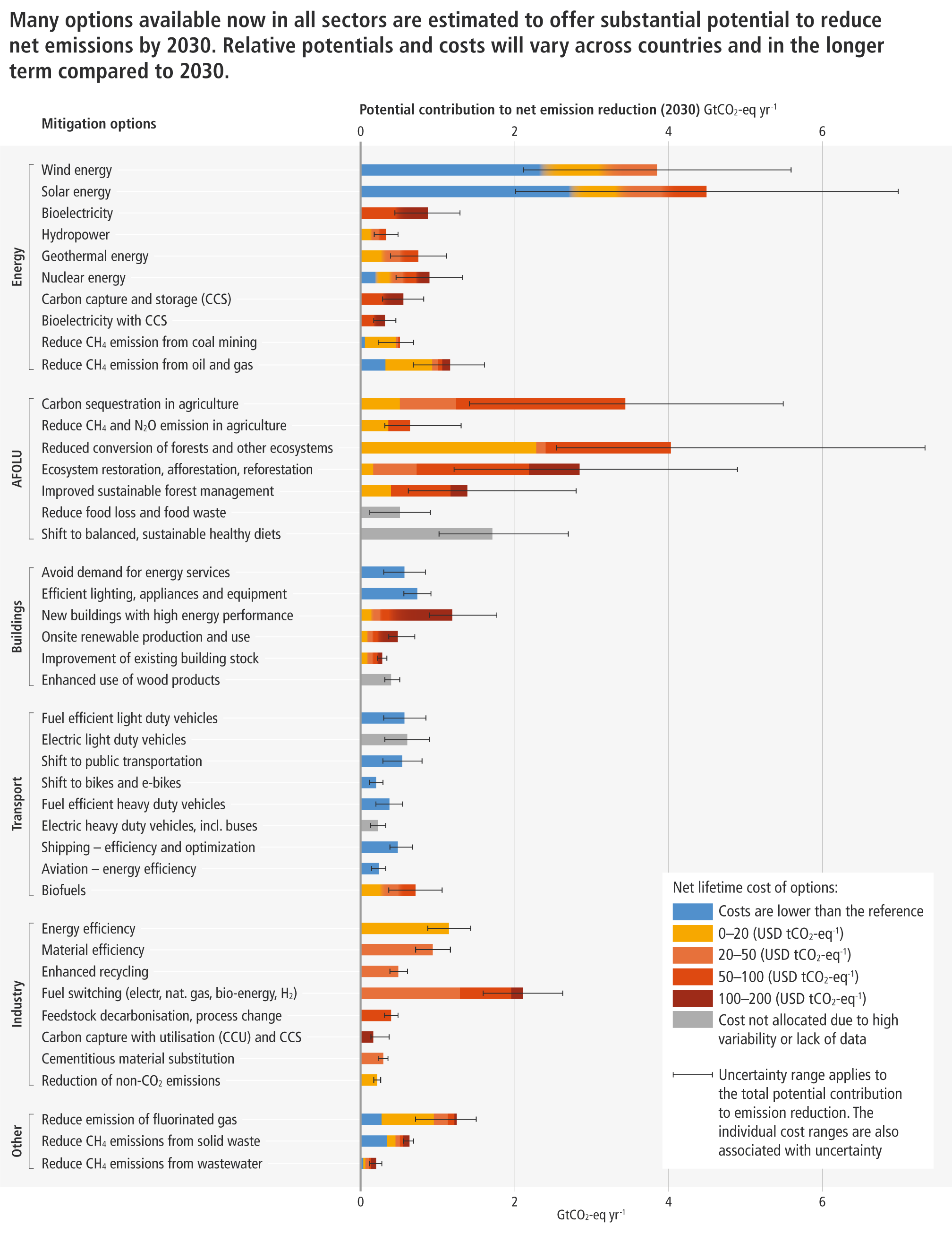
Behavior and lifestyle changes. Individual personal choices will never be sufficient to bring about the needed changes, but reducing air travel, shifting to plant-based diets, reducing food waste and overconsumption, turning down the heat, insulating houses, and electrifying vehicles can make a very significant contribution to the overall effort.
With gratitude for the scientists, the secretary-general, and the activists inviting us all to join in solving the climate crisis.
Russ Vernon-Jones of Amherst was principal of Fort River School for 18 years and is a member of the Steering Committee of Climate Action Now (CAN). The views expressed here are his own. He blogs regularly on climate justice at www.russvernonjones.org.